
Getting Fayette County Court Records
Work through whichever channel a given court supports. For civil and probate indexes from participating courts, try re:SearchTX. Then confirm what you find with the clerk before relying on it. The District Clerk posts no remote database for the public. Instead, the office offers an in-office public computer that covers public-open cases. County Clerk requests can start by email. The county contact form, phone, mail, or the counter also work. For a JP or municipal case, ask the issuing court directly.
- Identify the court and custodian from the case number, citation, pleading, or hearing notice.
- Ask for a specific existing docket sheet, filing, order, or judgment rather than “everything.”
- Give the case number, limited party names, filing range, document title, and plain-or-certified choice.
- Request a fee quote and accepted payment method before mailing payment.
- Ask for written notice if a record is sealed, redacted, restricted, or unavailable.
A phone call works well for procedure and fees. But when an office requires the request in writing, send the exact wording. One caution applies here. A listed fax number does not mean the office accepts fax for requests or filings.
Four Custodians, Four Record Paths
Fayette County splits its records among four custodians. The wrong counter means delays. It can also hand back a misleading "not found." The County Clerk and District Clerk divide the higher-level records between them, while each justice and municipal court keeps its own case files for lower-court matters.
| Custodian | Typical records | First route |
|---|---|---|
| County Clerk | County civil, misdemeanor, probate, guardianship | Phone, email/contact, mail, or counter |
| District Clerk | Felony, district civil/family, CPS, AG, juvenile | Phone or Room 102 public terminal |
| Justice court | Class C, small claims, justice civil, citation files | Issuing JP precinct |
| Municipal clerk | City ordinance and city Class C cases | Named city court |
A federal case tied to a Fayette address is another matter entirely. It lives outside the state courts. Under 28 U.S.C. §124, Fayette County falls in the Southern District of Texas, Houston Division, and PACER carries those federal dockets.
Court Record Types
A single case file can hold many pieces. The index is one thing; documents created at different procedural stages are another. Asking for the exact item saves search time. It also cuts copy charges. Keep in mind that public availability still depends on the case and the document.
- Docket sheet or filing register listing events and entries.
- Petitions, complaints, answers, motions, and other pleadings.
- Notices of hearing, settings, resets, and continuances.
- Signed orders, judgments, dispositions, and sentencing documents.
- Public exhibits or returns that the clerk has accepted into the file.
- Plain or certified copies of a named public document.
A calendar entry only shows an intended setting. It proves nothing about appearance, ruling, dismissal, conviction, payment, or final judgment. To know what happened, pull the matching docket entry and the signed order.
County Clerk Records Desk
Brenda Fietsam runs the County Clerk office at 246 W Colorado Street in La Grange. Mail goes to PO Box 59. The phone is 979-968-3251. Weekday hours are 8 a.m. to 5 p.m., with a noon to 1 p.m. closing. This desk handles county-court civil, misdemeanor, probate, guardianship, and other county records. Its published fee schedule lists county.clerk@fayettetx.us as well. The official County Clerk page confirms office identity and current routing. Use its live contact details. Ask whether a request should be mailed, emailed, or picked up at the counter.
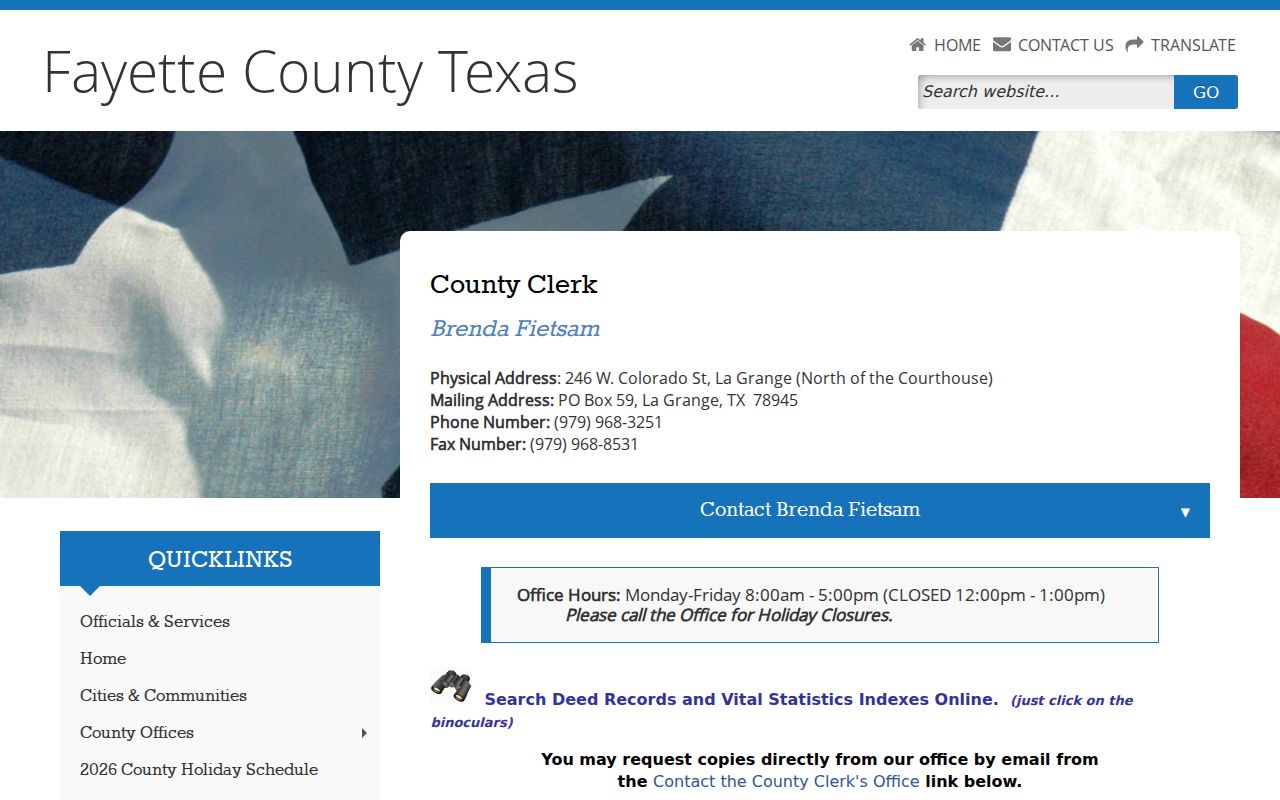
Note that the counter and the 151 N Washington courthouse are two different places, so confirm the right building before you travel.
Fayette County Clerk
246 W Colorado St.
PO Box 59
La Grange, TX 78945
979-968-3251
Monday–Friday, 8–5; closed noon–1.
Inside a Fayette County Court Record
What sits inside a court record depends on the tribunal. A smart request separates case-level metadata from the filed documents themselves. An online index may show only that first group, so plan accordingly.
| Case identity | Number, caption, court, county, and category. |
|---|---|
| Party/attorney data | Public names and roles, subject to privacy restrictions. |
| Docket entries | Dated filing, notice, hearing, order, and disposition descriptions. |
| Documents | Public pleadings, orders, judgments, and exhibits maintained in the file. |
| Settings | Scheduled dates, times, courtrooms, judges, and setting types when recorded. |
| Certification | Clerk authentication added to the requested public copy. |
A status like "open" or "disposed" comes from the source, not from the judgment itself. When a search result clashes with a signed order, ask the clerk to clarify the current docket.
District Records Use a Public Terminal
Linda Svrcek's District Clerk office sits in the Fayette County Courthouse at 151 N Washington Street. Look for Room 102. It keeps 155th District Court civil and felony files. Divorce, parent-child, tax, condemnation, CPS, Attorney General, juvenile, and other family and civil records are there too. Hours run 8 a.m. to noon and 1 to 5 p.m. The phone is 979-968-3548. Nothing is online for public viewing, the official page says plainly. What the office does provide is a public computer portal during office hours for public-open cases. Calling ahead is wise if you are out of county. It also helps when you want to mail a request.
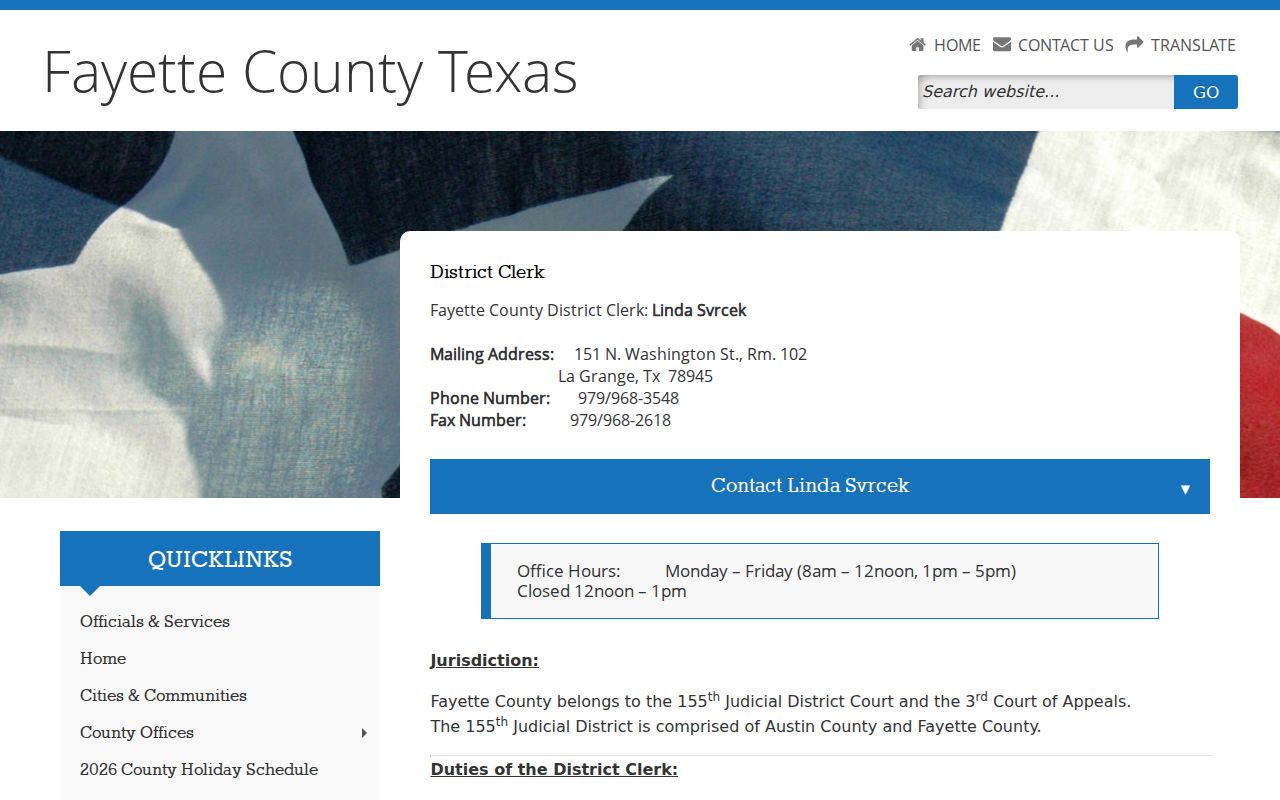
Ask the clerk to separate a public-open case from one that exists but holds restricted documents. Terminal access never overrides a sealing order or statute.
Fees and Certified Copies
The County Clerk fee PDF, updated July 17, 2026, anchors the local numbers. It sets a $5 search fee per name for probate, criminal, and civil searches. Plain copies cost $1 per page. Certification adds $5 on top of the $1 per page. Emailed or faxed copies are listed at $1 per page. A separate local e-filing FAQ tells a different story for delivery. It lists emailed copies at $2 per page and mailed copies at $1 per page. Keep the discrepancy in mind. Ask for a current quote before you pay.
| County Clerk item | Published amount |
|---|---|
| Name search for probate, criminal, or civil | $5 per name |
| Plain copy | $1 per page |
| Certified copy | $1 per page plus $5 certification |
| Email/fax in fee PDF | $1 per page; FAQ differs for email |
Do not carry County Clerk charges over to District Clerk, JP, municipal, or federal records without confirmation. Before paying, state the document title, page estimate, delivery method, and whether you need certification.
A Precise Request Gets Better Results
The Office of Court Administration policy is blunt on one point. A court has no duty to create a record that does not exist. So a request for an existing docket sheet or a named order works far better. It beats a request for a fresh narrative about a person. Give only the identifying details needed to locate the case. Never send Social Security numbers, complete birth dates, driver-license numbers, financial accounts, medical information, or a minor's private data. Do not send those through an ordinary contact form.
- Plain copy
- An unauthenticated reproduction of an available public document.
- Certified copy
- A copy carrying the clerk’s certification and related fee.
- Redacted record
- A public version with protected information removed.
- Sealed record
- A record withheld under a court order or applicable law.
Keep both your sent request and the office response. If the clerk asks for a fee deposit or a narrower date range, confirm that revision in writing.
Sealed Records and Public Access
Not every court file in Texas falls under the ordinary Texas Public Information Act rules. Government Code §552.0035 gives the judiciary special treatment. Under Supreme Court Rule 12, some non-adjudicative judicial-branch administrative records count as "judicial records." Case records are different. They usually follow common law, statutes, court rules, and the clerk or court that holds them. OCA guidance adds that Rule 12 does not ordinarily apply to elected district clerks. This routing distinction matters. Anyone seeking a Fayette County court docket that may be restricted should know which set of rules governs it.
The official OCA policy page highlights the same distinction. It is a fair starting point. Use it to find the correct process, not as a way around case confidentiality.
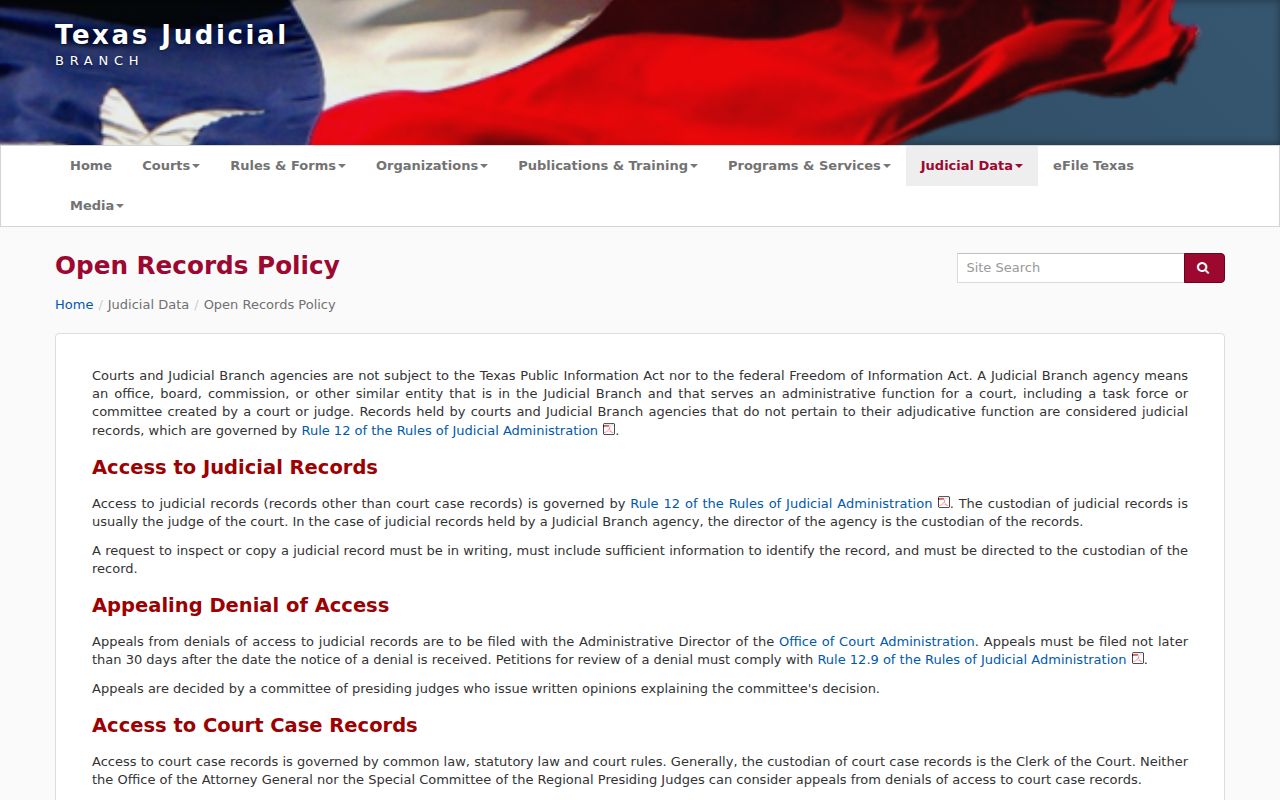
Certain records in the Fayette County court system stay out of public view. Juvenile files, CPS matters, some family and protective-order material, expunction and nondisclosure records, victim information, and sensitive identifiers can all be sealed, restricted, or redacted.
Mail, Email, and Counter Choices
Mail is a solid option once the clerk confirms the cost and accepted payment. Your request should be complete. Include a return address, phone or email, the case number, the filing range, and the exact documents. Say whether you want plain or certified copies. Add your delivery preference. County Clerk mail goes to PO Box 59, La Grange. District Clerk mail goes to Room 102, 151 N Washington. JP and municipal addresses differ by issuing court.
Email and the county contact form both create a written trail. Keep sensitive identifiers out of the message. At the counter, bring the case number and a precise document list. Plan for courthouse security and lunch closures. The District Clerk takes cash, check, or money order over the counter. It reports that cards are not accepted there. County Clerk payment options and card convenience fees follow its current schedule.
Note: Fayette County sets no fixed turnaround for court records requests. So ask when yours will be ready. Ask too whether certification changes the delivery method.