
Fayette County Court Calendars Explained
The 155th District Court puts out an official Fayette County schedule of upcoming settings. It shows docket dates, ancillary times, and criminal or civil labels. CPS settings get their own section. Treat it as a calendar, though, not a searchable case database. To confirm a setting, the official pages for the County Clerk, District Clerk, County Judge, the justice courts, and the district court each list contact routes. You can use any of them. Court level matters when you read a docket entry. Fayette County Court handles the county-level work. The 155th District Court serves both Austin and Fayette counties. Its primary location is listed in La Grange. On top of those, Fayette County runs four separate Justice of the Peace precincts. So a setting belongs to its named court and location. It need not happen at the Fayette County Courthouse, and it does not belong to the county as a whole.
Fayette District Docket Updates
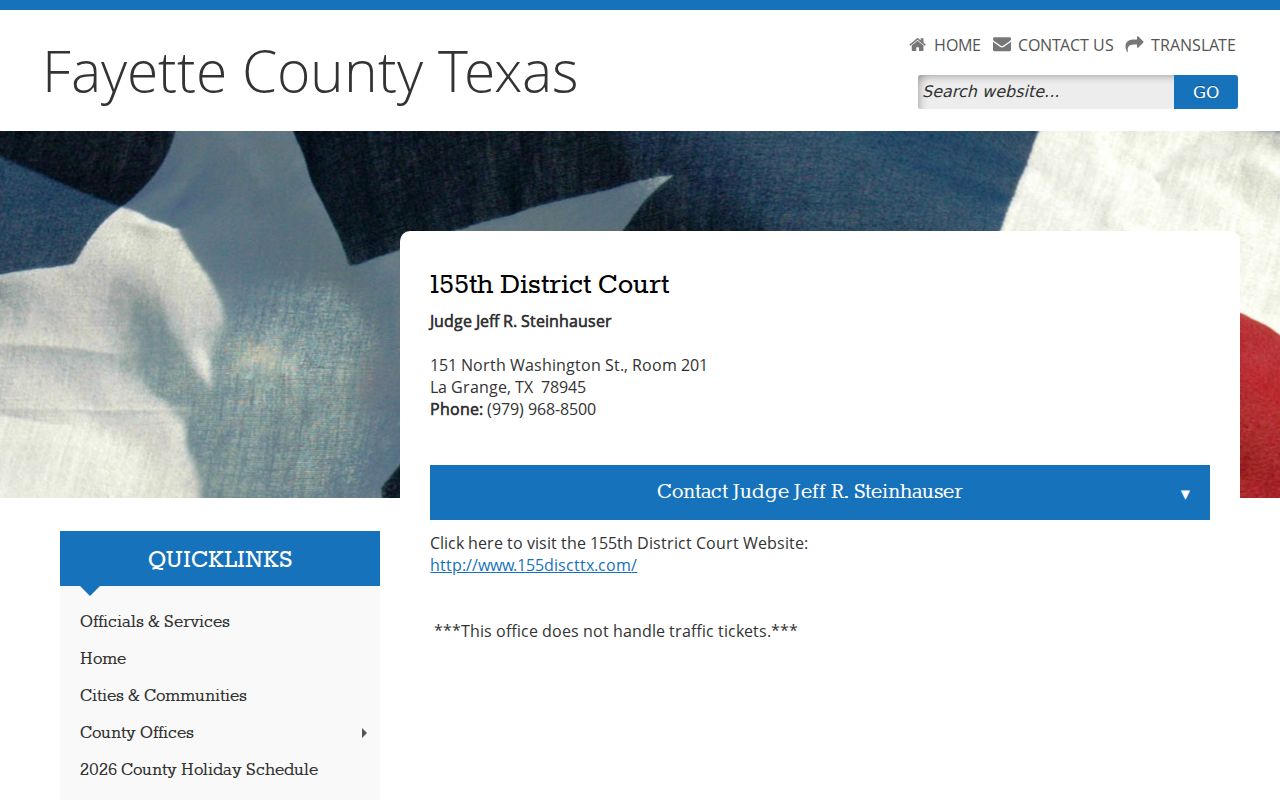
The official Fayette County 155th District Court page lists Fayette docket schedules online. Settings can shift. The judge may move a hearing, and the calendar changes to match. Nothing is locked in until docket call. A saved docket printout or an old notice only tells you what the schedule looked like at one moment in time, so confirm any court date with the clerk or the justice court that actually controls the setting before you plan around it.
The live schedule and the court coordinator confirm current settings.
Note: A public notice may announce official action, but it is not the same record as a case calendar or docket sheet.
Finding Your Court Date
Start with the strongest identifier you have. A cause number is best for county or district matters, while a citation number helps a justice court find a fine-only case. A party name and filing date can help when the number is unknown. Fayette County offers several access channels, and none covers every calendar.
- Check re:SearchTX after registering or signing in. Choose Hearings and open the case or hearing details when a possible match appears.
- For county court, contact the County Clerk at 979-968-3251 or county.clerk@fayettetx.us. For district court, contact the District Clerk at 979-968-3548, visit Room 102, or mail 151 N Washington, La Grange, TX 78945.
- For a JP matter, call or email the precinct on the citation. JP1 uses 979-968-3648, JP2 uses 979-378-2573, JP3 uses 361-865-3500, and JP4 uses 979-743-4041.
- Check the 155th Fayette schedule for district settings, and ask whether a courtroom posting or docket call also applies. The court must confirm any change.
- Compare the case number, court, date, time, setting type, and location. A represented party should also confirm instructions with counsel.
The District Clerk offers a public computer portal in Room 102 during office hours for public-open cases. Call 979-968-3548 first.
Fayette District Court Locations
The 155th District Court's two-county service area is the key calendar check. The official district-court page gives La Grange as the primary location. That alone does not tell you where a Fayette County hearing will occur. Confirm the county, the building, and the room attached to the setting. The court page lists 979-968-8500, and the District Clerk remains the local record contact.
Never infer place from the judge's main office. A Fayette caption does not mean every event happens in La Grange. Ask whether the event is in person. Ask whether another county hosts it, and whether remote appearance was expressly authorized. County local rules allow a remote short-hearing request with advance coordination. But remote appearance must be approved and confirmed.
When the location is unclear, give the full cause number. Describe the document that supplied the date. Ask the court to read back the place, start time, and event type. Also ask whether check-in begins before the listed time. Ask whether any written order changed the site. The county homepage does not state parking, security screening, accessibility, or courthouse device rules. Those practical facts must come from the court before travel. The same care applies to justice settings. Precinct 1 is tied to La Grange. Precinct 2 is tied to Fayetteville. The current justice page provides contacts rather than a public schedule. The office named on the citation is the sound starting point.
How to Read a Court Setting
The official Fayette schedule shows docket dates, ancillary times, criminal or civil labels, and CPS settings. Those details still need current confirmation. Read them together, since a date without the court or setting type tells you little.
| Date | The scheduled day, checked against any later reset or order. |
|---|---|
| Time | The start time and whether it is a group docket call or individual hearing. |
| Courtroom | The building, city, and room, especially for district court. |
| Judge | The court or judicial officer assigned; assignments may change. |
| Setting Type | The purpose, such as an initial setting, plea, pretrial, trial, compliance, or show-cause hearing. |
A detail screen may also show parties, filings, and status. Those help identify the case, but the clerk should confirm the next required appearance.
Fayette County Setting Terms
Short terms state why a case is on the list. They do not all mean the case ends that day. Read Fayette County court dates with the latest order and the setting court's own instructions.
- Setting
- A scheduled event tied to a case.
- Docket call
- A session in which the court calls several matters and checks status or readiness.
- Continuance
- A court-approved move to a later date.
- Reset
- A new setting that replaces an earlier one; it is not a dismissal.
- Trial
- A proceeding that decides disputed issues, distinct from pretrial or status work.
Continuances, Resets, and Cancellations
Asking for a continuance does not itself move a Fayette County court date. Only the court can do that. Ask the clerk or JP how to file the request. Ask whether a written motion is needed, and whether the current appearance stays required until an order is signed. The county posts no online reset form or public cancellation feed.
When a date changes, get the new date, time, court, place, and setting type. Look for a filed order. But do not treat a missing statewide entry as proof the old date stands or the case ended. State materials note limits for criminal and older records.
Note: Keep the written reset notice with the cause number so the replacement setting can be matched to the correct case.
Fayette County Hearings Online
re:SearchTX offers four ways to dig: Cases, Text in Documents, Hearings, and Filings. Sign in with eFileTexas credentials, or register for an account. Then a searcher picks a search type, applies filters, and opens the details of anything useful. Results can be saved or exported. The Hearings area is where a Fayette County court date might surface.
That is a big maybe, though. The 2024 OCA Data Committee report sketches broad holdings while flagging criminal records as a gap. Most cases only go back to 2016. So a blank result does not mean your case is absent. Try the County Clerk instead. The District Clerk, the proper JP, the public terminal, or a tight written request are other routes. The Fayette County case lookup spells out how each of those search types differs.
Fayette Calendar or Public Notice
The 155th Fayette schedule page is the official district setting channel, but it is not a full case docket. Know what you are reading. A calendar entry ties an event to a cause. A docket sheet logs events and filings together. A schedule entry simply gives notice of a planned setting. Treat the three as distinct, because one cannot safely stand in for another.
OCA Court Activity Reporting differs again. It holds fiscal-year totals and court statistics, not party names, pleadings, or dates. Use it to gauge how busy a court is. Never use it to confirm an appearance. For that, the setting court and the clerk are the final checks.
If You Miss a Court Setting
Missed a Fayette County court date? Act promptly. Call the court listed on your case or citation, give the cause or citation number, and ask what the status is now and what lawful step comes next. County or district questions start with the right County Clerk or District Clerk. Justice cases go to the correct precinct. A lawyer can lay out your duties and options.
Missed a Setting? A missed appearance can lead to added court action, including a failure-to-appear process in an eligible case.
Do not pay through a vendor or arrive at court until the court confirms the case, amount, appearance duty, and location.
Only the court can state current status; seek advice from a licensed attorney when legal action may be pending.
Certified Payments shows up on the clerk and justice pages as a way to pay, not as a calendar search. Paying a fine may not cancel your duty to appear. Before you use it, ask the court exactly what payment means for your case.