
How to Search Cases by Name
Texas re:SearchTX is the official statewide entry point, and it covers civil and probate cases and filings from courts that participate. It is not a full Fayette County criminal database. Names repeat, so expect similar matches. Narrow the list with location, case category, filing period, and the case caption.
- Choose the likely custodian: County Clerk, District Clerk, justice court, or municipal court.
- For civil or probate, open re:SearchTX and enter the party name shown on the filing.
- Apply the live location, case category, case type, and date filters.
- Compare the case number, court, party role, and filing date before opening a result.
- Ask the clerk to confirm the docket or certify a document when formal proof is needed.
| Field | Type | Required | Use |
|---|---|---|---|
| Party name | Text | Search-dependent | Start with surname; do not treat a name match as identity. |
| Location | Dynamic filter | No | Select Fayette County when offered. |
| Category/type | Dynamic filter | No | Separate civil, family, probate, and other matters. |
| Date range | Date filter | No | Limit the indexed filing period. |
Four re:SearchTX Result Views
The official guide splits discovery into four views. Cases pulls up a caption and number. Filings tracks submitted items, Hearings locates indexed settings, and Text in Documents searches inside available document content. All four draw on the statewide corpus, so they do not promise that Fayette County supplies every docket entry or image.
- Cases
- Case-level matches such as court, number, caption, and category.
- Filings
- Indexed submissions subject to local integration and access.
- Hearings
- Scheduled events where the source court transmits them.
- Text in Documents
- Searchable language where images and permissions allow it.
A hearing hit only means a setting was indexed. It does not prove the hearing happened. Nor does it show that a ruling issued. For the real answer, read the later docket entries and the signed order.
The official statewide portal page shows the civil and probate search entry point. Seeing it first helps you recognize the system. That helps before you type any search terms.
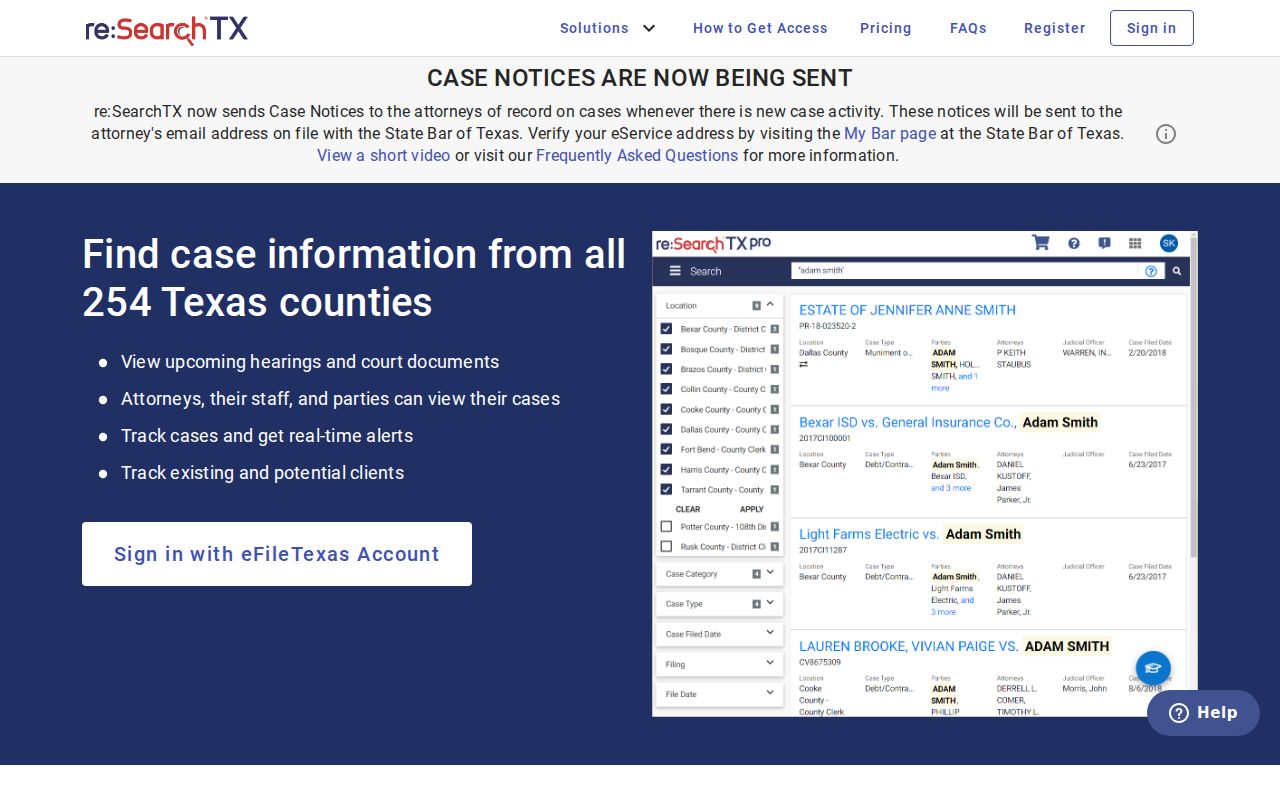
Use the live portal’s current controls because categories can change as courts integrate data.
How to Search by Case Number
A complete case number is the strongest lookup key. It points to one court file, no spelling required. Fayette County sources show no single format shared across the County Clerk, the 155th District Court, four justice precincts, and the municipal courts. Treat the exact court-issued number as an identifier copied straight from a citation, notice, pleading, or order. Do not invent year or case-type segments, and keep the punctuation and leading zeroes intact.
Match the number to its office. A 155th District Court number belongs with the District Clerk. A county-court civil, misdemeanor, or probate number goes to the County Clerk. A citation number goes to the JP or municipal court printed on the ticket.
A rejected number does not mean no case exists. The formatting may differ, the court may be a different one, indexing may lag, or access may be restricted.
The District Clerk Terminal Route
The Fayette County District Clerk does not put records online for public viewing. Instead, the office provides a public computer terminal. You will find it in Room 102 of the Fayette County Courthouse, 151 N Washington Street, La Grange. Hours are 8 a.m. to noon and 1 to 5 p.m. The phone is 979-968-3548. Only public-open cases appear there. Statewide search sometimes comes up empty on a district civil, felony, family, juvenile, CPS, or Attorney General matter. Then this terminal is the clearest fallback in Fayette County.
Call ahead before you drive over. Ask whether the file is public and whether the terminal can locate it. Also ask how to request copies. Bring the case number, party names, filing period, court level, and a precise list of documents. Terminal visibility never makes sealed or confidential documents copyable.
Fayette County District Clerk
Linda Svrcek, District Clerk
Room 102, 151 N Washington St.
La Grange, TX 78945
979-968-3548
Hours: 8 a.m.–noon and 1–5 p.m.
What a Case Search Shows
A Fayette County case search can reveal plenty of metadata. It can identify the right file and trace its procedural history. Which fields appear depends on the court and the source. Statewide results may include case and filing indexes. The District Clerk terminal shows only public-open district cases. Municipal portals, by contrast, lean on citation-specific fields.
| Case number | The court identifier used for accurate clerk requests. |
|---|---|
| Case caption | The styled title; similar names require verification. |
| Court/location | The tribunal and county controlling the original file. |
| Category/type | The source’s civil, probate, family, or other classification. |
| Filed date/status | Index dates and open, closed, or disposed labels. |
| Filings/hearings | Indexed submissions and settings; images may be unavailable. |
Status can lag behind a signed order, and a setting alone proves neither appearance nor judgment. For deadlines, read the filed order and confirm with the clerk.
When a Case Is Not Online
"Not found" is not "no record." re:SearchTX is a civil and probate discovery layer. OCA materials state that criminal records sit outside its statewide corpus. The District Clerk offers an in-office terminal rather than a remote public database. Justice and municipal courts keep separate files entirely. Recheck the spelling and number. Pin down the jurisdiction. Then contact the office holding the court docket.
Route each Fayette County matter to the right clerk. County-court civil, misdemeanor, probate, and guardianship records go to the County Clerk. Reach that office at 979-968-3251 or 246 W Colorado Street. District matters go to the District Clerk. Class C and citation cases go to the issuing court printed on the ticket. Do not substitute eFileTexas. It exists for filing. Registering there creates no public search access.
County vs Statewide Case Search
Fayette County has no single portal for every court. re:SearchTX handles remote civil and probate discovery across participating courts. The local clerks remain the authoritative custodians, and the District Clerk terminal covers public-open district cases that may not be viewable remotely.
| Point | re:SearchTX | Local clerk |
|---|---|---|
| Coverage | Participating statewide civil/probate data | The responsible Fayette County file |
| Access | Remote search interface | Phone, counter, request, or terminal |
| Limit | Not a complete criminal corpus | Restricted material stays restricted |
| Best use | Discovery when court is uncertain | Verification, copies, certification |
Use the statewide result to learn the court and case number. Then ask the clerk about copy charges and current status.
La Grange Uses Four Search Modes
The La Grange Municipal Court portal accepts four search modes. You can search with a citation number plus date of birth. A driver-license number works with the state and date of birth. A vehicle plate works with just the state. So does a name plus date of birth. It covers city municipal matters only, not the county docket. A La Grange address alone proves nothing about jurisdiction. A county citation may belong to JP1 instead.
If the ticket names La Grange Municipal Court, start with the citation number. One caution: the portal warns users not to pay online for driver-safety-course or deferred-disposition requests. Contact the court instead.
Restricted Cases and Access Rules
Not everything in a Fayette County court docket is open. Juvenile files, CPS matters, some family and protective-order material, expunctions, nondiscorders, sealed cases, victim data, protected addresses, and sensitive identifiers can all be withheld. Some may simply be redacted. The rules for handling sensitive data and sealing in civil filings appear in Texas Rules 21c and 76a.
When you ask the clerk for a docket sheet, filing, or order, give its number. Ask for notice if part of the record is restricted. A blank search result proves nothing about a person.
From Search Result to Certified Record
Once a Fayette County docket search points you to the right case, write down the details that matter. Grab the court, the county, the case number, the document title, and the filing date. Then reach out to the clerk who holds the record. The County Clerk fee schedule shows $1 per page. Certification adds $5 on top of the per-page cost. Probate, criminal, and civil searches carry a $5 per-name search fee. A separate local FAQ lists different pricing for emailed copies. Ask for a current quote through whichever channel you use.
Know what kind of copy you want before you call. A plain copy just reproduces a public document. A certified copy carries the clerk's certification, and it may follow special delivery rules. State your choice. Give a return contact and delivery method, then wait for the fee math. The Fayette County court record search page walks through the full workflow.
Note: Search results only locate records. The clerk where the case was filed supplies the authoritative, current certified copy.